

Foot Reflexology
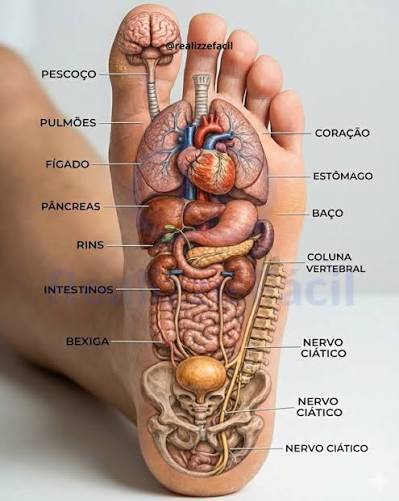
Reflexology is based on the principle that all organs, glands and parts of the body have reflex points in the hands and feet, and that by working these points on the hands and feet it is possible to reduce tension at the reflex points, relieving tension in any part of the body and, consequently, bringing about a sense of well-being.
Brief History
Various ancient civilizations, such as the Egyptians and the Chinese, already practiced something similar to this technique. In the mid-15th century, European countries such as Germany and England were already conducting studies on Reflexology, referred to at the time as "zone therapy." Sources indicate that indigenous peoples of Central and North America also already treated illnesses through the feet. But it was in 1917 that otolaryngologist Dr. William Fitzgerald published his book titled "Zone Therapy," mapping the position of organs and body areas onto the feet. His studies enabled another important figure in the history of Reflexology, Dr. Joseph S. Riley, to develop detailed diagrams of the reflex points located in the feet.
However, the greatest contribution came from Dr. Joseph S. Riley's assistant, American physiotherapist Eunice Ingham. She was responsible for organizing the work on reflex areas, mapping the feet as a map of the entire body. She went on to guide her therapeutic work according to this map. For a long time, she supplemented all existing knowledge with her own experience. This made it possible to refine the theory of foot reflexes. This work resulted in two books: "Stories the Feet Can Tell" and "Stories the Feet Have Told."
The Body–Feet–Hands Relationship
The relationship between the body and the feet and hands is very special. Being sensitive organs, they touch and traverse the world around us, perceiving it and manipulating it. After birth, one of the great tasks of the human being is to stand upright on two legs and move upon them (walking).
Developing this ability requires the involvement and combination of muscular stretching, joint angularity, nerve communications, and considerable pressure on the feet. The feet and hands develop the movements needed for outward expression, while the internal organs supply the fuel. Every movement requires an expenditure of energy.
Throughout the day, a silent dialogue takes place between the internal organs and those responsible for locomotion. Every movement or expression requires updated, uninterrupted information. If there's an interruption in the energetic or sensory (communication) systems, a "tilt" may occur, such as a fall, for example. Sensory signals have a major impact on these systems, as does the body's overall tension level. Tension is characterized as a state of readiness involving the entire organism.
Hands and feet, being sensitive organs of locomotion, maintain a special relationship with the body. Because of this relationship, they serve as a means of interacting with the body's overall state of tension and energy consumption.
Application in Our Sessions
At the end of sessions, we use Foot Reflexology as a way to reintegrate the Earth element, seeking to relieve tension and stimulate specific points on the feet that will help ground and steady the patient/client in the present moment. This procedure provides greater support and grounding to the physical body's energetic balance, following the many energetic interactions that occurred during the therapeutic session.